

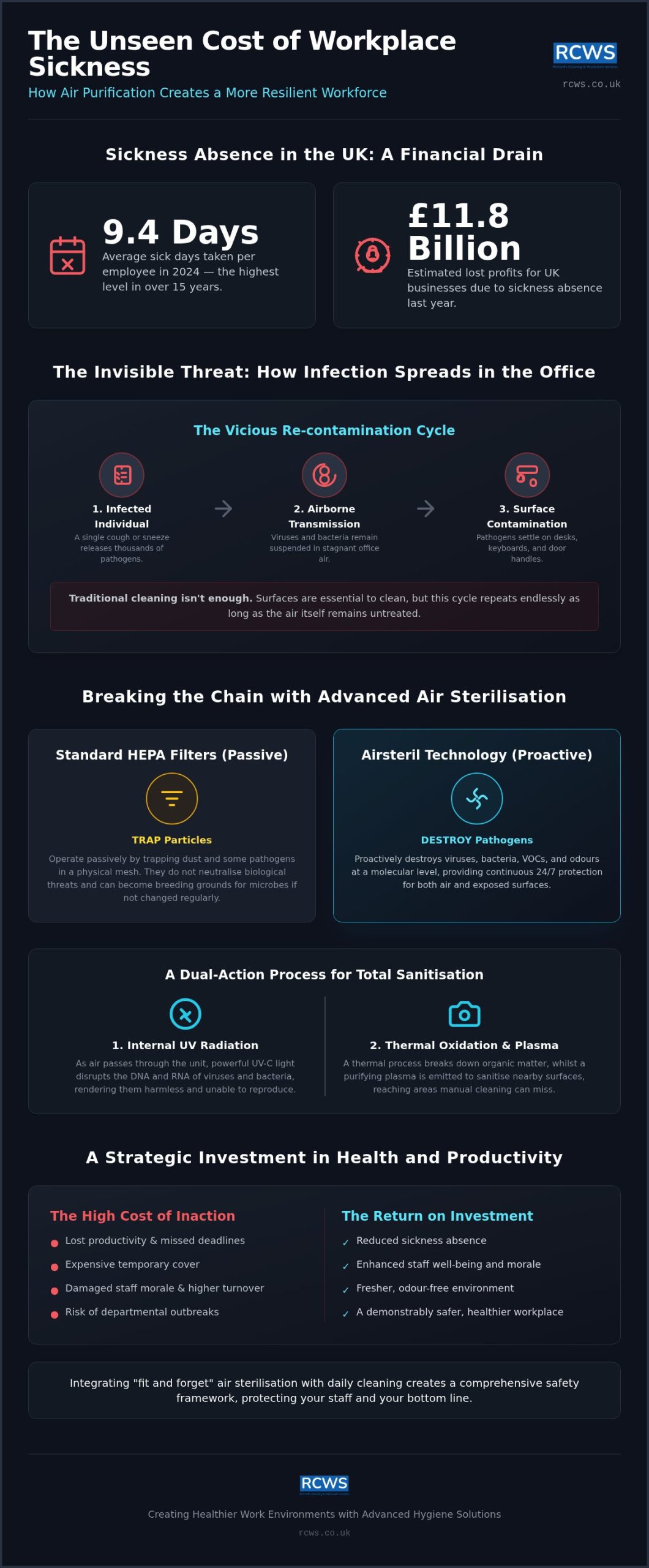
UK employees took an average of 9.4 sick days in 2024, the highest level in over 15 years, contributing to an estimated £11.8 billion in lost profits for businesses last year. For directors across the North East, these figures represent the persistent challenge of managing temporary cover and the disruption caused by recurring seasonal viruses. You’ve likely perfected your daily cleaning schedules and washroom standards, yet the invisible threat of airborne pathogens remains a significant risk to your staff’s health and your company’s productivity.
We understand that addressing “invisible” hygiene can feel like an intangible investment. However, reducing sickness absence with air purification is now a proven method for protecting your bottom line and enhancing staff morale. In this guide, we’ll explain how professional Airsteril units provide a “fit and forget” solution that continuously sanitises both the air and exposed surfaces. You’ll discover how integrating this technology creates a demonstrably healthier environment, ensuring your organisation remains resilient against the high costs of absenteeism whilst maintaining the highest professional standards of safety and care.
Key Takeaways
- Understand the hidden financial impact of respiratory illness on business continuity and why standard hygiene protocols often fall short of protecting your staff.
- Learn the technical distinction between standard air filtration and the advanced thermal oxidation used by Airsteril to neutralise airborne viruses and bacteria.
- Discover the strategic benefits of reducing sickness absence with air purification, comparing the modest cost of managed units against the high expense of lost productivity.
- Identify the most effective placement for air sterilisation units within your facility to maximise protection in high-risk areas like washrooms and boardrooms.
- Explore how integrating air purification with your daily office cleaning routine creates a comprehensive, “fit and forget” safety framework for your workforce.
The Financial Impact of Sickness Absence on UK Businesses
Sickness absence is a significant drain on the UK economy, costing businesses an estimated £11.8 billion in lost profits during 2025. Whilst the direct cost of Statutory Sick Pay (SSP) is a visible burden, the indirect losses often prove more damaging. These include missed deadlines, the high cost of temporary cover, and the administrative strain of rescheduling work. For directors in the North East, where absence rates frequently track higher than the national average, these figures represent a serious threat to operational efficiency. The average UK employee took 9.4 sick days in 2024, a statistic that highlights the necessity of a more robust hygiene strategy.
Much of this disruption stems from a failure to address the chain of infection within shared workspaces. Stagnant office air is a primary culprit behind Sick Building Syndrome, a condition where poor ventilation allows pollutants and pathogens to accumulate. Traditional methods often overlook the air as a vector for disease. By prioritising reducing sickness absence with air purification, businesses can mitigate these risks and protect their workforce from the revolving door of seasonal respiratory infections.
Why Traditional Cleaning Isn’t Enough
Surface sanitisation is an essential component of office hygiene, yet it cannot address the pathogens that remain suspended in the air. Even after a thorough daily clean, a single cough from an infected individual can re-contaminate a workspace in seconds. This creates a “re-contamination cycle” where surfaces are constantly being compromised by airborne particles. Professional air sterilisation is required to break this cycle by neutralising threats before they can settle.
The Hidden Costs of Presenteeism
Presenteeism occurs when staff attend work whilst ill, often out of a misplaced sense of duty. This behaviour is counterproductive. It accelerates the spread of germs amongst the team, frequently leading to departmental outbreaks that are far more costly than a single person’s absence. Beyond the immediate health risk, a workplace that feels unhygienic or unsafe significantly damages staff morale and can lead to higher turnover rates as employees seek healthier environments.
How Advanced Air Purification Breaks the Chain of Infection
Standard HEPA filters are often the default choice for office managers, yet they operate on a passive principle by trapping particles within a mesh. Whilst effective for dust, they do not necessarily neutralise the biological threats that cause illness. In contrast, Airsteril technology represents a proactive shift in reducing sickness absence with air purification. It doesn’t just trap pathogens; it destroys them at a molecular level. This distinction is vital for businesses that require a dependable hygiene strategy rather than a simple filtration system.
The process relies on a sophisticated combination of thermal oxidation and internal UV radiation. As air passes through the unit, the UV light disrupts the DNA of viruses and bacteria, rendering them harmless. Simultaneously, the thermal oxidation process breaks down organic matter. This dual-action approach ensures that the air returned to the room is sterile. Because these units operate 24/7, they provide a continuous shield that physical cleaning, which is often limited to a few hours a day, cannot match. This constant operation is particularly effective in high-traffic offices across Newcastle and Sunderland where the risk of cross-contamination is highest.
Eliminating Odours and Volatile Organic Compounds (VOCs)
Stale air in boardrooms or near high-volume printers often contains high levels of VOCs and unpleasant odours. These are not merely a nuisance; they’re linked to reduced cognitive performance and increased fatigue amongst staff. Airsteril units effectively remove these chemical vapours, ensuring the environment remains fresh and conducive to productive work throughout the day.
Surface vs. Airborne Protection
One of the most significant advantages of this technology is its ability to treat surfaces. The units emit a purifying plasma that travels throughout the room, reaching the underside of desks and other high-contact areas that manual sanitisation might miss. This constant treatment reduces the need for aggressive chemical sprays, creating a more sustainable and less intrusive hygiene framework. If you’re looking to enhance your current Daily Office Cleaning Services, integrating these units provides the final, essential layer of protection for your workspace.
Calculating the ROI: Why Air Purification is a Strategic Investment
Investing in workplace health is often viewed as a necessary expense, yet the financial logic of reducing sickness absence with air purification suggests a significant return on investment. The estimated annual cost of absenteeism per UK employee is approximately £3,029. When you consider the cumulative expense of Statutory Sick Pay, temporary staff cover, and lost productivity, the business case is clear. The monthly investment in a managed Airsteril unit is often lower than the cost of a single day of sick pay and lost output. For businesses in Newcastle and Gateshead, this represents a transition from reactive crisis management to proactive asset protection.
Adopting this technology signals a commitment to safety that bolsters your reputation as an employer of choice. It provides several key advantages for your operational budget:
- Full alignment with the latest UK ventilation frameworks and health and safety standards.
- A reduction in the chemical footprint and volume of janitorial supplies required for manual sanitisation.
- Enhanced protection against the financial disruption of departmental outbreaks.
Directors who prioritise high standards understand that this “safe pair of hands” approach is essential for protecting both professional reputations and the bottom line.
Boosting Employee Confidence and Productivity
Visible hygiene measures, such as the discreet installation of air units, significantly reduce health-related anxiety amongst your team. Beyond the psychological benefit, the removal of fine particulates leads to a measurable reduction in office-based headaches and lethargy. This creates an environment where staff can maintain focus throughout the working day, directly improving your company’s overall output.
Long-term Savings on Building Maintenance
Poor air quality doesn’t just affect people; it degrades your physical assets. Reducing airborne dust and preventing mould growth protects sensitive office electronics and preserves the condition of your decor. Maintaining these commercial building maintenance standards ensures your facility remains a high-quality asset whilst lowering long-term repair costs. To secure your workplace against the hidden costs of illness, explore our bespoke managed hygiene services today.
Integrating Airsteril with Your Daily Office Cleaning Routine
Implementing a professional air purification strategy in Newcastle or Gateshead starts with a structured assessment of your facility’s layout. It’s not enough to simply place a unit in a corner; effective results require strategic positioning in high-traffic zones. By integrating these units with your daily office cleaning services, you create a dual-layered defence. Whilst your cleaning team removes physical debris and sanitises surfaces, the Airsteril system continuously addresses the microbiological load in the air. This synergy ensures that your workspace doesn’t just look clean but is biologically safe for every occupant.
Local businesses benefit significantly from partnering with a North East provider for this integration. Regular maintenance, such as annual lamp changes and internal cleaning of the units, is essential to ensure the technology remains effective. Having a dependable partner nearby ensures that your system never experiences downtime. This proactive approach is the most reliable way of reducing sickness absence with air purification whilst maintaining a professional hygiene standard that protects your corporate reputation.
Washroom Hygiene: The Critical Zone
Washrooms are the primary source of airborne bacteria in any commercial building. Every flush releases aerosolised pathogens that can linger for hours. Achieving local washroom excellence requires more than just clean tiles; it necessitates the constant neutralisation of these airborne threats. Airsteril units in these zones eliminate odours and bacteria at the source, preventing them from migrating to open-plan office areas where they can spread amongst the team.
A Managed Service Approach
A truly “fit and forget” solution is only possible through a managed service contract. We recommend a comprehensive site survey to determine the exact requirements for your space, ensuring the correct number of units are installed for maximum efficacy. This structured approach guarantees that your investment in reducing sickness absence with air purification delivers measurable results year after year. It removes the administrative burden of maintenance from your team, allowing you to focus on core operations whilst we manage the safety of your environment.
Securing Your Workplace Against the Hidden Costs of Illness
We’ve established that airborne pathogens represent a significant yet manageable risk to your business continuity. By moving beyond surface cleaning and addressing the air itself, you protect your staff from the persistent disruption of seasonal viruses. The shift from passive filtration to active sterilisation provides a proactive shield that operates 24/7, ensuring that high-traffic zones like washrooms and boardrooms remain demonstrably safe.
Reducing sickness absence with air purification is a strategic move that delivers a measurable return through improved productivity and reduced administrative strain. As an authorised provider of Airsteril technology with local expertise across Newcastle, Gateshead, and Sunderland, we offer bespoke hygiene solutions that integrate seamlessly with your existing routines. Our team provides the meticulous maintenance required to ensure your environment remains healthy, serving as a dependable partner for your professional reputation.
Request a professional air quality survey for your North East office today and take the first step towards a more resilient workspace. Protecting your team is a vital investment in your company’s future success.
Frequently Asked Questions
How much can air purification really reduce sickness absence?
The exact reduction depends on your facility’s layout and occupancy levels. However, by neutralising pathogens before they spread, businesses can break the cycle of cross-infection that leads to departmental outbreaks. This proactive approach is a proven component in reducing sickness absence with air purification, helping to mitigate the impact of the 9.4 average annual sick days taken by UK employees in 2024.
Is Airsteril better than a standard HEPA air filter for an office?
Airsteril technology provides a more robust defence than standard HEPA filters. Whilst HEPA systems are passive and merely trap particles within a mesh, Airsteril units actively destroy biological threats using UV light and thermal oxidation. This ensures that viruses and bacteria are eliminated rather than stored, making it a superior choice for organisations focused on reducing sickness absence with air purification and maintaining sterile environments.
Where should air purification units be placed for maximum effect?
Units should be positioned in “critical zones” where bacterial counts are naturally higher or where staff congregate. This includes washrooms, where aerosolised pathogens are a constant risk, as well as boardrooms and reception areas. Correct placement ensures the purifying plasma reaches all corners of the room, treating surfaces and the air simultaneously to provide the highest level of protection for your workforce.
Are air purification units noisy or disruptive in a quiet office?
No, the units are engineered for discreet use in professional settings. Many models operate silently or with a very low decibel output that is comparable to a quiet computer fan. This allows for continuous 24/7 air sterilisation without causing any distraction to employees in quiet offices or meeting rooms, ensuring that safety doesn’t come at the expense of productivity.
Do air purifiers require a lot of maintenance?
When integrated into a managed hygiene contract, these units require very little internal effort. They are designed for continuous operation and typically only need an annual lamp replacement and a periodic internal service to maintain their sanitising power. Partnering with a professional provider ensures these tasks are handled automatically, providing a dependable, low-maintenance solution that protects your business and your professional reputation.