

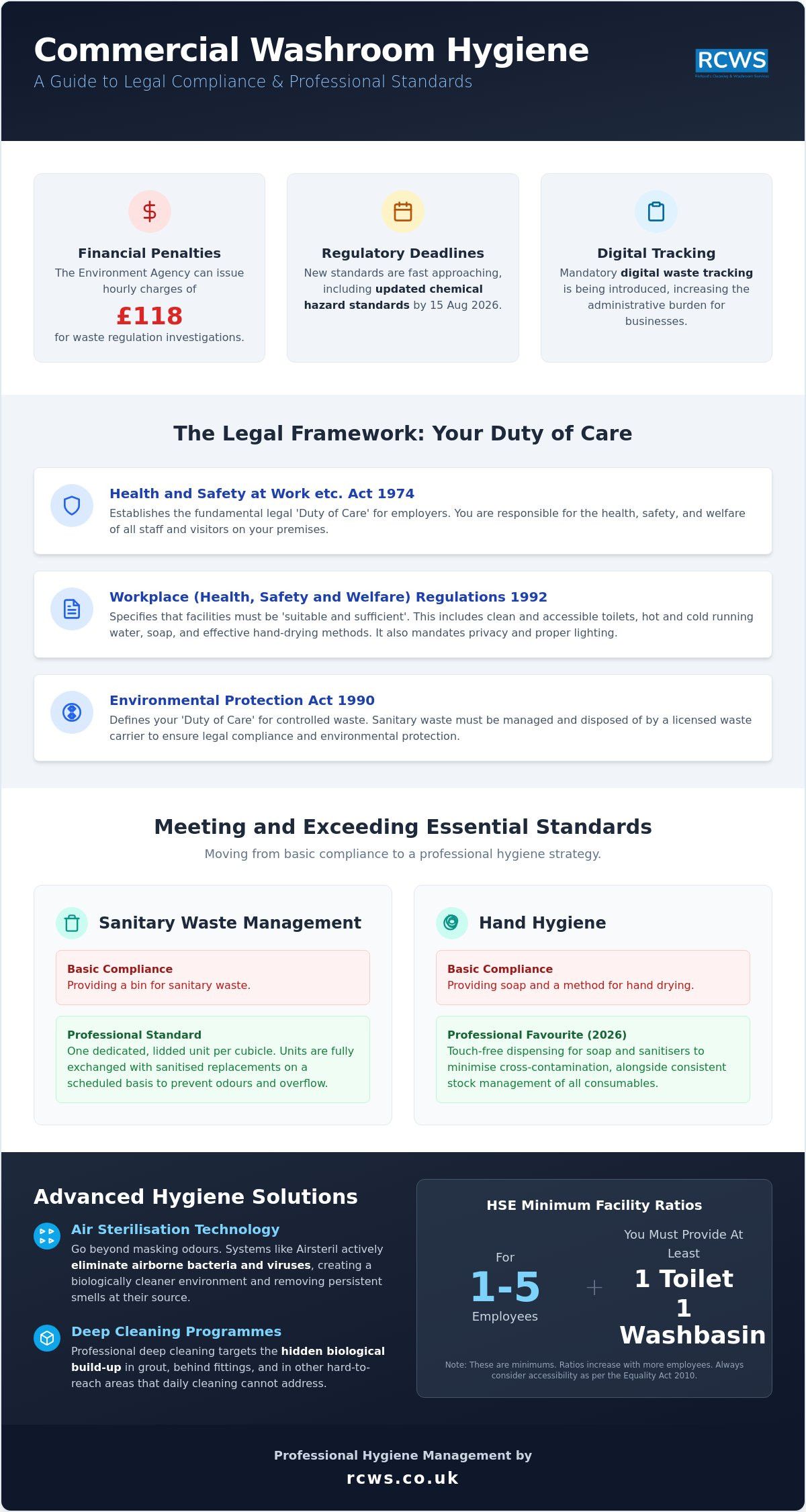
Maintaining commercial washroom hygiene standards is no longer just a matter of professional pride; it’s an increasingly complex legal obligation with significant financial penalties for those who fall behind. You likely understand that a clean facility is vital for staff morale and visitor impressions, but the administrative burden of staying compliant can feel relentless. With the Environment Agency now authorised to issue hourly charges of £118 for waste regulation investigations, the cost of oversight is higher than ever. From the August 15, 2026 deadline for updated chemical hazard standards to the introduction of mandatory digital waste tracking in October, the regulatory landscape is shifting rapidly.
This guide provides a definitive overview of the legal requirements and professional benchmarks you must meet to ensure your business remains safe, compliant, and efficient. We’ll examine the fundamental legislation, including the Workplace (Health, Safety and Welfare) Regulations 1992 and COSHH, whilst exploring how professional management eliminates persistent odours and supply chain frustrations. By the end of this article, you’ll have a clear roadmap for creating a superior environment for your team and a strategy to reduce the daily administrative weight of managing hygiene services.
Key Takeaways
- Identify the specific legal obligations your business must meet under the Health and Safety at Work Act 1974 and the Workplace (Health, Safety and Welfare) Regulations 1992.
- Understand the essential benchmarks for sanitary bin provision and why touch-free dispensing has become the 2026 professional favourite for hand hygiene.
- Learn how to maintain commercial washroom hygiene standards that protect your professional reputation whilst fulfilling your ‘Duty of Care’ to staff and visitors.
- Discover how air sterilisation technology like Airsteril moves beyond masking odours to actively eliminate bacteria and viruses from the environment.
- Gain a clear framework for managing washroom facilities that reduces cross-contamination and ensures a cleaner, more professional workplace.
The Legal Framework for Commercial Washroom Hygiene in the UK
Commercial washroom hygiene standards in the UK are defined by a strict intersection of the Health and Safety at Work etc. Act 1974 and the Workplace (Health, Safety and Welfare) Regulations 1992. These acts establish the baseline for safety and welfare in every professional environment. For employers in Newcastle and across the North East, this creates a legal ‘Duty of Care’ toward both staff and visitors. You’re responsible for maintaining facilities that aren’t just functional but are biologically safe and dignified.
Maintaining these commercial washroom hygiene standards requires a structured, documented programme that can withstand an audit or inspection. This includes specific provisions for adequate ventilation to prevent damp, sufficient lighting for safety, and a clear ratio of facilities based on staff numbers. For instance, the HSE mandates that a business with 1 to 5 employees must provide at least one toilet and one washbasin. Privacy is equally paramount; facilities must be enclosed by lockable doors to protect the dignity of all users.
To better understand the practical application of these regulations, watch this helpful video:
The Workplace (Health, Safety and Welfare) Regulations 1992
Under these regulations, sanitary conveniences must be ‘suitable and sufficient’ and easily accessible. This means facilities should be within a reasonable distance of workstations and maintained in a clean condition. You must provide hot and cold running water, soap, and effective hand-drying methods. Modern Public toilet standards also incorporate the Equality Act 2010, which ensures that inclusive design for disabled users is a mandatory requirement rather than an optional extra.
Environmental Protection and Waste Management
The Environmental Protection Act 1990 outlines your ‘Duty of Care’ for controlled waste generated on your premises. This is particularly relevant for sanitary items. Sanitary waste must be handled by a licensed carrier to avoid legal repercussions and ensure safe disposal. Partnering with a specialist for sanitary bin collection Newcastle ensures your business remains compliant with these environmental obligations whilst protecting your professional reputation.
Essential Standards for Sanitary Waste and Hand Hygiene
Meeting commercial washroom hygiene standards requires a meticulous approach to waste and sanitation. It isn’t enough to simply provide a bin; the professional standard dictates one unit per cubicle, serviced at a frequency that prevents overflow and eliminates odours before they develop. This proactive management ensures that your facility remains welcoming and compliant with the legal framework established by The Workplace (Health, Safety and Welfare) Regulations 1992. For businesses in the North East, maintaining these standards is a critical component of reputation management.
Daily maintenance is essential for surface cleanliness, but it doesn’t replace the need for periodic deep cleaning. Whilst daily routines handle visible soilage, professional deep cleaning targets the biological build-up in hard-to-reach areas, such as behind fittings and within grouting. This dual approach is the only way to achieve long-term hygiene goals and prevent the persistent smells that often lead to poor user feedback. Consistent management of consumables, such as soap and paper, is also vital. A washroom that lacks basic supplies is a washroom that fails to meet professional benchmarks.
Professional Sanitary Bin Services
Legally, sanitary waste is classified as controlled waste. Businesses in Sunderland and Durham must prioritise professional waste documentation to prove they’re meeting their ‘Duty of Care’. Professional services involve a discreet, scheduled collection process that goes beyond simple emptying. A high-standard service involves the full exchange of sanitised units. This ensures that the hardware itself doesn’t become a source of bacteria, providing a safer environment for all users. Many facility managers across the region who have experienced the frustrations of anonymous call centres and inconsistent service from large national providers are now seeking a phs group alternative in the North East that offers genuine local accountability and responsive service delivery.
Effective Hand Drying and Soap Provision
Touch-free dispensing has emerged as the 2026 professional favourite for reducing cross-contamination in the workplace. By removing the need for physical contact, you significantly lower the risk of germ transmission between users. When considering hand drying, high-speed HEPA-filter dryers are often more efficient than paper towels in high-traffic areas, provided they’re maintained correctly. Placement is equally vital; dispensers should follow a logical user flow to prevent water from dripping onto floors, which creates a slip hazard. Managing these requirements is simplified when you secure reliable janitorial supplies Sunderland businesses depend on in bulk, ensuring your team never faces depleted soap or paper stocks.
Advanced Hygiene: Air Sterilisation and Reputation Management
Air sterilisation represents the modern frontier for commercial washroom hygiene standards in 2026. Traditional maintenance often relies on heavy fragrances to mask unpleasant smells, but this approach fails to address the underlying biological causes of odours. Airsteril technology shifts the focus from concealment to eradication by eliminating bacteria and viruses in the air and on surfaces. This level of environmental control is essential for modern businesses that prioritise the health of their occupants over mere aesthetic cleanliness.
The psychological impact of washroom hygiene shouldn’t be underestimated. Clients and staff often view the state of these facilities as a direct reflection of a company’s overall professional standards and operational discipline. A poorly maintained environment suggests negligence, whereas a sterile, odour-free space reinforces a reputation for excellence. Establishing this standard begins with robust daily office cleaning services, which provide the necessary foundation for advanced hygiene technologies to be truly effective.
The Role of Airsteril in Infection Control
Airsteril units utilise a sophisticated combination of UV light and ozone to destroy airborne pathogens. This process breaks down the DNA of bacteria and viruses, rendering them harmless. Unlike manual cleaning, which is periodic, this technology provides 24/7 protection that continues to work between scheduled cleaning shifts. Implementing such systems is a proven strategy for reducing staff sickness air purification, offering a tangible return on investment through improved workplace attendance. This proactive approach aligns with the latest UK workplace welfare regulations, ensuring that your facilities exceed basic legal requirements.
Maintaining Standards Through Professional Partnerships
Sustaining these high benchmarks requires a cleaning partner who understands the specific commercial needs of the North East. Choosing a single-source provider for cleaning, washroom services, and commercial janitorial supplies Sunderland facilities rely on reduces administrative friction and ensures consistency across all your facilities. If your organisation is currently locked into a rigid national contract that lacks responsiveness, exploring a dedicated local washroom excellence provider as a phs group alternative for North East businesses could significantly improve both compliance outcomes and service consistency. It’s advisable to conduct a proactive audit of your current washrooms to identify any gaps in 2026 compliance. By consolidating these services, you ensure that every aspect of your washroom meets a unified, professional standard that protects both your staff and your reputation.
Securing Your Professional Reputation Through Compliance
Adhering to the latest commercial washroom hygiene standards is a fundamental requirement for any serious organisation. We’ve explored how a robust legal framework protects your business, whilst modern technologies like Airsteril and touch-free dispensing move beyond basic cleanliness to provide active infection control. When you prioritise these facilities, you aren’t just fulfilling a ‘Duty of Care’; you’re reinforcing your commitment to staff welfare and professional excellence. Maintaining these benchmarks requires a meticulous approach that integrates daily maintenance with specialised waste management.
Richard’s Cleaning and Washroom Services offers the expertise needed to navigate these regulatory demands effectively. As expert Airsteril providers and fully licenced waste carriers for the North East, we provide a comprehensive service that includes daily office cleaning integration. Our team ensures your facilities remain safe, compliant, and welcoming for every user. To ensure your premises meet the 2026 benchmarks, request a professional washroom hygiene audit from Richard’s Cleaning and Washroom Services today. Taking this proactive step protects your professional reputation and provides peace of mind for your entire team.
Frequently Asked Questions
What are the legal requirements for sanitary bins in UK workplaces?
Under the Workplace (Health, Safety and Welfare) Regulations 1992, employers are legally required to provide a suitable means for the disposal of sanitary dressings in ladies’ washrooms. This is typically achieved by placing a dedicated bin in every cubicle. Since this material is classified as controlled waste, it’s essential that a licenced carrier manages the collection and disposal to ensure your business remains compliant with environmental legislation.
How many toilets should a commercial office have per employee?
The Health and Safety Executive (HSE) provides a specific scale to determine the minimum number of facilities required. For a workforce of 26 to 50 employees, for example, you must provide at least three toilets and three washbasins. Following this proportional scale is vital to ensure that commercial washroom hygiene standards are maintained and that staff have adequate access to welfare facilities throughout the working day.
Is air sterilisation a legal requirement for commercial washrooms?
Air sterilisation isn’t currently a strict legal requirement, but it’s becoming a professional benchmark for businesses that want to exceed basic ventilation standards. Whilst the law requires “suitable and sufficient” fresh air, Airsteril technology goes further by actively destroying airborne pathogens. Implementing these systems demonstrates a proactive approach to your ‘Duty of Care’, protecting both your staff and your professional reputation in a way that manual cleaning alone can’t match.
How often should a commercial washroom be professionally cleaned?
At a minimum, professional cleaning should take place daily to ensure your commercial washroom hygiene standards don’t slip. In high-traffic environments, you may require multiple service visits per day to manage consumable levels and sanitise high-touch surfaces. It’s also important to supplement these daily routines with periodic deep cleans, which target the biological build-up in areas that are often overlooked during standard maintenance cycles.